Bounded autonomy: why the best agents know when to stop
The most useful agents are not the ones that act without limits. They are the ones that understand when to proceed, when to ask, and when to hand control back.
Contents5 sections
The instinct behind most AI products is simple: give the system more autonomy.
Let it answer more questions, complete more tasks, move faster, touch more tools and require less human involvement. On paper, that sounds like progress. In practice, autonomy without boundaries quickly becomes a product problem.
The best agents are not the ones that do the most. They are the ones that know what they are allowed to do, what they know with confidence, and where their authority ends.
That is the difference between an agent that feels useful and one that feels dangerous.
The trust budget
Every agent operates with a trust budget.
Users are usually comfortable letting software do low-consequence work without interruption: retrieve information, classify an enquiry, prepare a draft, populate a record, summarise a conversation or suggest a next step.
The threshold changes when the action becomes consequential.
Sending a commercial proposal, changing a booking, committing to a delivery date, issuing a refund, moving money or making a decision on behalf of a customer are not simply larger versions of the same task. They carry a different level of authority.
The mistake is to treat all actions as though they sit on one continuous automation spectrum.
They do not.
A good agentic product makes these boundaries explicit. It separates what the system may do automatically from what it may prepare, recommend or escalate.
Autonomy is not the absence of constraints. It is the ability to act confidently inside well-designed ones.
The result is not a less capable agent. It is a more dependable one.
Boundaries as design material
Boundaries are often treated as backend rules: permissions, confidence thresholds, escalation conditions and tool access.
But they are also part of the user experience.
A person should be able to understand, without reading a policy document, what the system is doing on its own and what still requires them.
That might mean an agent can qualify a sales lead and schedule an available slot, but cannot negotiate a custom discount without approval. It can prepare a response to a support issue, but escalates when the customer asks for compensation. It can identify that a document is missing, but does not make a legal judgement about the customer’s eligibility.
The interface should make those transitions legible.
When boundaries are invisible, every successful autonomous action creates confidence until one unexpected action destroys it. When the boundaries are visible, the system becomes predictable.
Predictability is one of the foundations of trust.
The escalation framework
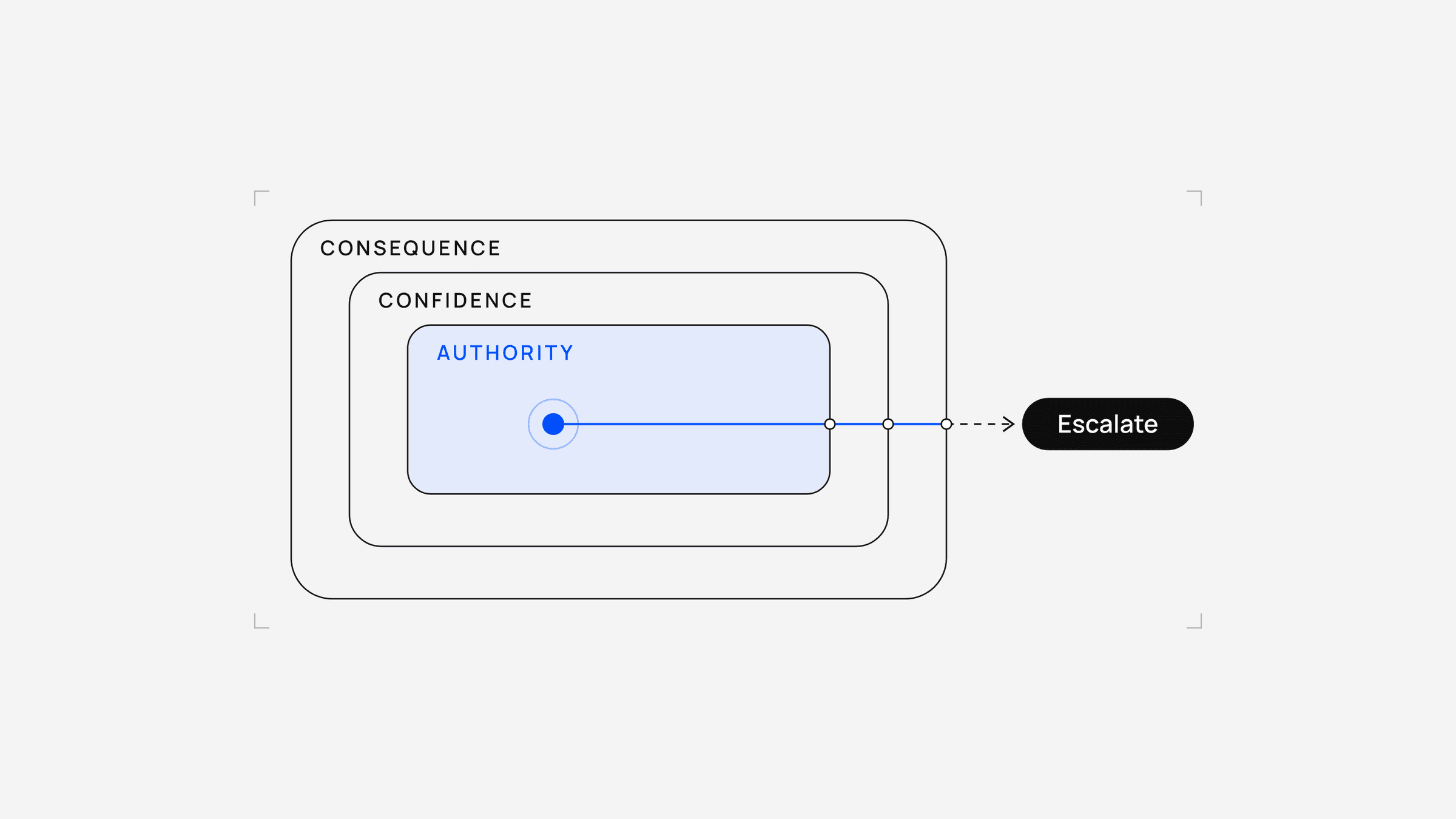
A useful way to design agent behaviour is to separate three decisions.
1. Can the agent act?
This is primarily about authority.
Does it have permission to perform the action? Is the action reversible? Is it inside the agreed workflow? Has the user already established a rule for this situation?
An agent may know exactly what to do and still not be authorised to do it.
2. Does the agent know enough?
This is about evidence and uncertainty.
Does it have the required information? Are important fields missing? Are sources conflicting? Is the user’s request ambiguous? Does the action depend on a fact that the system cannot verify?
The correct behaviour under uncertainty is often to narrow the problem before acting.
3. What happens if it is wrong?
This is about consequence.
Some mistakes are cheap. Others create contractual, financial, reputational or operational damage.
The higher the consequence, the stronger the case for confirmation, escalation or a constrained action.
These three questions create a practical boundary model: authority, confidence and consequence.
Can the agent act?
Authority · permission
Not authorisedEscalate
Authorised
Does the agent know enough?
Evidence · uncertainty
UncertainAsk
Enough evidence
What happens if it is wrong?
Consequence · reversibility
CostlyEscalate
Cheap, reversible
- Proceed
An agent should proceed autonomously only when all three are inside an acceptable range.
Escalation is a feature
Escalation is often described as a failure state. That framing is backwards.
A system that knows when to involve a person is more mature than one that attempts to complete every task.
The handoff itself should be designed carefully. A useful escalation should include the context already gathered, what the agent believes is happening, what it tried, why it stopped and what decision is now required.
That prevents the familiar experience where the human has to restart the interaction from zero.
The goal is not to remove people from the loop. It is to make human attention selective.
People should appear where judgement, authority or ambiguity genuinely requires them—not because the system failed to carry context forward.
Autonomy should be earned
There is another reason boundaries matter: they let autonomy increase over time.
An agent does not need maximum authority on day one.
It can begin in recommendation mode, move into approval-based execution, and eventually gain permission to act automatically in specific, well-understood situations.
- RecommendThe agent suggests; a person acts
- Execute with approvalThe agent acts once a person approves
- Execute autonomouslyIn specific, well-understood situations
Delegated authority
That progression creates a better product relationship than asking the user to trust a fully autonomous system immediately.
It also gives teams a way to learn where the real edge cases are.
The most useful agentic systems will not be defined by how aggressively they remove humans. They will be defined by how precisely they allocate human attention.
That is what bounded autonomy gets right.
The agent acts when it should, stops when it must, and makes the boundary between those two states part of the product.